
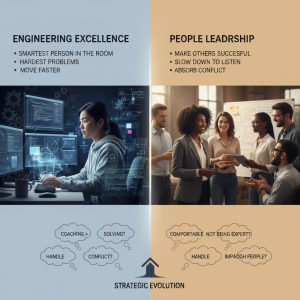
 For many high-performing engineers, the question isn’t whether management is an option, but it’s when it becomes the expected next step. You perform well, deliver consistently, and demonstrate leadership on complex high-visibility projects. Eventually, someone suggests that you “take the next leap”. However, that upward upward mobility means you’d have to manage people, and not be the technical expert (in most cases).
But engineering excellence and people leadership are not the same craft. They reward different instincts, different behaviors, and different measures of success. Engineering rewards clarity, logic, and precision. Management rewards navigating ambiguity, emotional intelligence, and influence. Moving from one to the other is not a promotion in the traditional sense, but a strategic career decision that requires a lot more thought than it typically receives.
As an engineer, success can often looks like:
- Being the smartest person in the room
- Owning the hardest problems
- Moving faster than everyone else
As a manager, success can look like:
- Making other people successful
- Slowing down to listen
- Absorbing conflict without reacting
Engineers are trained to analyze, optimize, and arrive at the best possible answer. Management, however, lives in uncertainty and complexity. People do not respond predictably. Motivation fluctuates. Conflict is sometimes illogical. Progress often happens without clear metrics or immediate feedback.
Even engineers who have led technical projects are often surprised by this shift. Project leadership emphasizes outcomes and execution. People leadership requires emotional regulation, influence without authority, and the ability to prioritize long-term team health over short-term efficiency. These are skills rarely taught in engineering curricula, yet they determine whether a manager succeeds or quietly burns out.
For underrepresented engineers in particular, this can carry additional weight. Management can mean increased visibility, unspoken expectations, and the responsibility of representation. It may also mean navigating organizational politics that reward perception as much as performance.
The most effective “engineers-turned-managers” are those who choose the role intentionally. They recognize that their impact will no longer come from being the strongest individual contributor, but from enabling others to thrive. They invest in learning skills they were never formally taught: coaching, feedback, conflict resolution, and strategic communication.
Before saying yes to the transition, ask yourself:
- Do I enjoy coaching more than solving?
- Am I comfortable not being the expert?
- Can I handle conflict without internalizing it?
- Do I want impact through people, not personal output?
The question, then, isn’t whether high-performing engineers should become managers. It’s whether they are ready and willing to redefine what success looks like. When management is approached as a well thought out strategy rather than an automatic next step, it becomes not a departure from engineering excellence, but an evolution of it.
Leave a Reply